
Missed calls are a System Problem, not a You Problem.
Missed Calls Costing Your Small Business? Fix the System

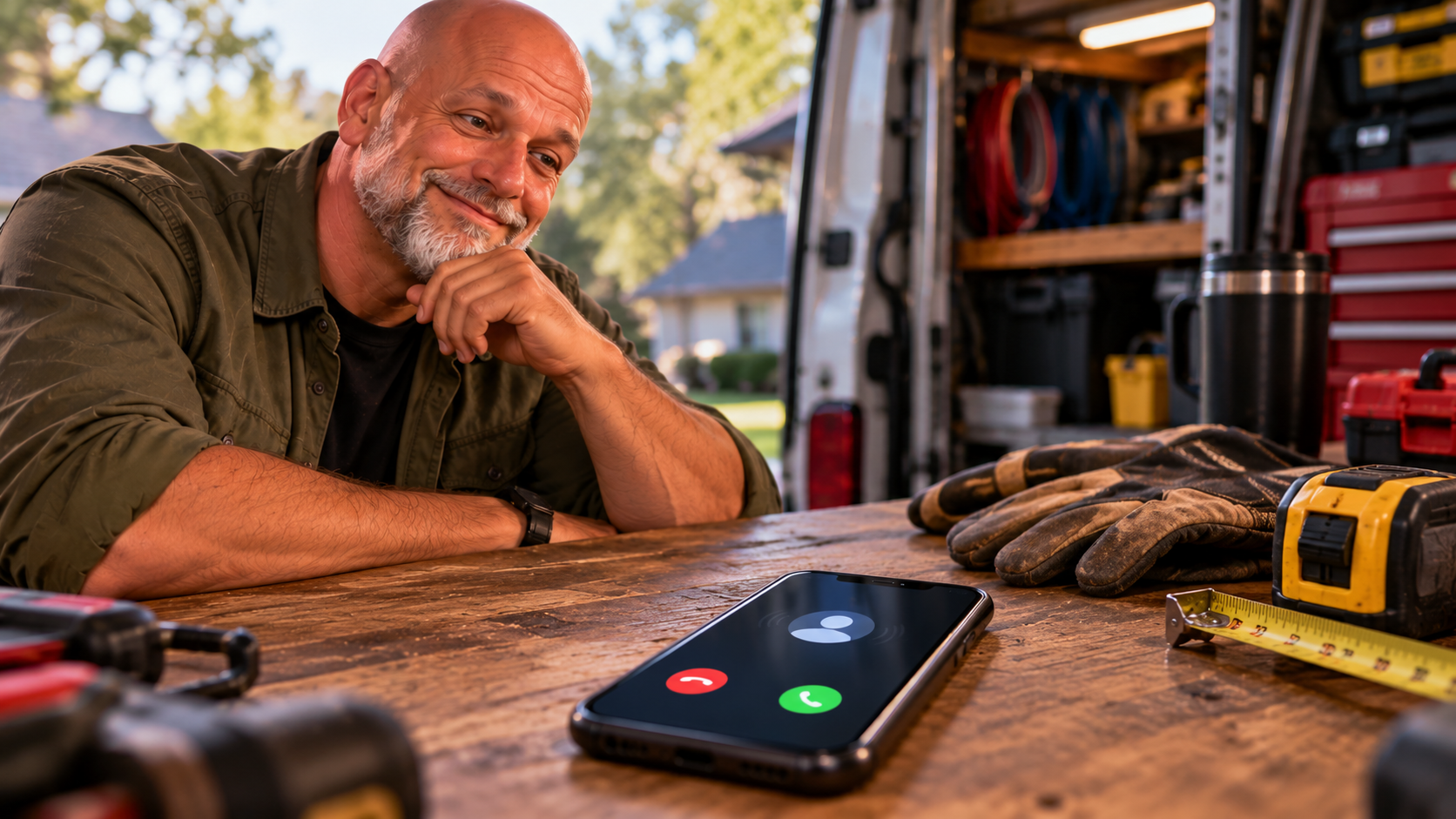
Monday morning, you check voicemail. Three messages. Then you pull up the call log and count eleven missed calls from numbers you don't recognize. Eight people called, didn't leave a word, and went somewhere else. You weren't lazy. You were working. And that's exactly the problem.
What Is a Missed-Call Problem?
A missed-call problem is when a business routinely lets inbound calls ring out or roll to voicemail because nothing is set up to catch them. It's rarely about effort. Small businesses miss calls because the owner and crew are busy doing the work, and no system answers, responds, or follows up when they can't.
How Many Calls Does a Small Business Actually Miss?
Most small businesses miss more than half their calls without knowing it. When 411 Locals tracked 85 small businesses across 58 industries for 30 days, only 37.8% of calls reached a live person. Another 37.8% hit an answering machine and 24.3% got no answer at all (411 Locals).
That study is a few years old, so here's a current one. Invoca's 2026 analysis of more than 70 million calls found 44% of callers never reach a person, and that's across businesses big enough to pay for call tracking (Invoca, 2026). In home services specifically, only 52% of callers reach a live person (Invoca Home Services Benchmarks 2026).
If the companies with call centers are missing nearly half, the one-truck operation isn't doing better.
What Happens When a Customer's Call Goes Unanswered?
Most of them leave, and they don't come back. In a 2025 CallRail survey of 1,000 U.S. consumers, 78% said they've abandoned a business after an unanswered call, and 82% said they'll call a competitor if you don't pick up (CallRail, 2025).
Voicemail isn't the safety net you think it is. In that same survey, only 42% of consumers said they leave a voicemail when nobody answers. The majority hang up. You never get a name, a number you'd recognize, or a reason to call back.
The customer who calls you is usually calling two or three businesses in a row. The first one that answers gets the job. That's the business down the street, and it's not better than you. It's just faster. (More on that in [our lead response time pillar](LINK: lead-response pillar).)
Why Isn't Missing Calls My Fault?
Because you can't be on a job and on the phone at the same time, and no amount of hustle changes that. Missed calls happen at the exact moments you're doing the work that pays the bills: on a roof, under a sink, with a client, driving between jobs.
Trying harder doesn't fix it. Keeping the phone in your shirt pocket doesn't fix it. Even a receptionist only covers business hours, lunch breaks, and one call at a time. The calls that slip through aren't a discipline failure. They're the gap where a system should be.
That's the good news. A people problem is hard to fix. A systems problem has a systems answer.
How Much Does a Missed Call Cost a Small Business?
It costs you whatever that caller would have spent, and you can estimate it in two minutes. Here's the math:
Missed calls per week × share that are real leads × your close rate × your average job value = revenue walking out the door.
For a benchmark on the second number, Invoca found 38% of answered calls from digital marketing are qualified leads (Invoca, 2026).
Run an example with made-up but realistic numbers: 10 missed calls a week × 38% leads = about 4 real buyers. Close one in three, at an $800 average job, and that's roughly $1,000 a week. Over a year, that's more than $50,000 in work you already paid to attract with your ads, your listing, and your truck wrap.
Plug in your own numbers. Most owners don't like the answer.
What Does a System for Missed Calls Look Like?
A real system answers the call, catches the ones that slip through, chases the lead, and shows you all of it in one place. Here's what that looks like with Edgewood's Never Miss a Lead System™:
Answer. An AI voice agent picks up when you can't, holds a real conversation, answers common questions, and captures what the caller needs.
Catch. If a call is missed, missed-call text-back fires automatically within seconds, so the caller gets a text from you before they dial the next business.
Chase. Automated follow-up keeps working the lead until they reply, instead of relying on you to remember on Friday.
See. One reporting dashboard shows every call, answered or missed, so you know what's leaking instead of guessing.
None of this is flashy. It's the boring stuff. And the boring stuff moves the needle.
Is Missed-Call Text-Back Enough by Itself?
No. It's the floor, not the ceiling. Text-back saves callers who would have walked, but it can't answer a question or book a job in the moment. It works best paired with something that actually picks up the phone. We break that down in [What Is Missed-Call Text-Back, and Is It Enough by Itself?](LINK: missed-call text-back cluster, Nov 10)
How Do I Find Out How Many Calls I'm Missing Right Now?
Start with your phone's call log or your carrier's call history for the last 30 days. Count every inbound call that wasn't answered, then count how many of those you actually called back. The gap between those two numbers is your leak.
Missed calls are one of four leaks most local businesses have. See the full picture in
The Four Leaks Draining Every Local Business.
Frequently Asked Questions
Do people still leave voicemails for businesses?
Fewer than half do. In CallRail's 2025 survey of 1,000 U.S. consumers, only 42% said they leave a voicemail when a business doesn't answer (CallRail, 2025). Everyone else hangs up, and many call a competitor instead.
Will my customers actually talk to an AI on the phone?
More of them than you'd expect. In the same CallRail survey, 66% said they'd use AI to check business hours or location, 50% would use it to book an appointment, and 52% said businesses using AI after hours provide better service (CallRail, 2025).
Should I just hire a receptionist instead?
A receptionist helps during business hours, but they take lunch, go home at five, and answer one call at a time. An automated system covers nights, weekends, and the second call that comes in while the first one is on the line. Many businesses use both.
How fast should I call back a missed call?
Within minutes, not hours. The MIT/InsideSales lead response study (2007) found leads contacted within five minutes were 21 times more likely to qualify than leads contacted after 30 minutes. Missed-call text-back gets a response out in seconds, even when you're still on the job.
Find Out What You're Missing
Call It Yourself. Right Now.
Don’t take our word for it. Call
501-270-6890- and hear exactly what your customers would hear. Ask it a question. Try to book a job. Throw it a curveball. It takes two minutes. Then picture that same system answering your phone tonight while you’re asleep, and tomorrow while you’re on a roof.
Share this article
Read More Related Blogs